Configuration & Administration
- Permission sets
- DEXPRO Core
- Breeze Interface Setup
- Document Class Setup
- Target Template Setup
- Generic Custom Fields
- OAuth 2.0 setup (for SaaS only)
- Breeze Workflow
- Authentication (on-premises)
Permission sets
In order to use the modules, the appropriate authorization set must be assigned to the respective users.
The following are supplied with:
-
DXP Core Admin - DEXPRO Core Administrator
-
DXP Core User - DEXPRO Core User
- DXP BREEZE Admin - DEXPRO BREEZE Administrator
- DXP BREEZE User - DEXPRO BREEZE User
DEXPRO Core
The DEXPRO Core manages the individual DEXPRO apps and their documents per client.
All documents that have been entered and processed via the various DEXPRO modules in Microsoft Dynamics 365 Business Central are displayed. A global number series, which is used across all DEXPRO apps, is used to complete individual documents. This offers the advantage that users only have to work with one number series per document.
Further information can be found here.
Breeze Interface Setup
In the Breeze Interface setup, processing is set up within the app.
Process
Copy Setup
This copies the setup to other clients.
Navigation
Document class setup
Target Template Setup
General
In this FastTab you can enable/disable the use of this app.

No. Series
The number series for the Breeze Interface documents is stored here.

Viewer
This FastTab contains the Viewer in Documents setting (Boolean). If enabled, a document-viewer factbox is shown on the Breeze Documents page, so that the original document can be previewed directly while processing the Breeze entry. This setup group is only visible when the SQUEEZE app is installed.
{add screenshot of the Viewer FastTab with the "Viewer in Documents" toggle here}
Document Class Setup
In the document class setup, each document class is configured for processing. The document class setup is cross-app and is managed via the DEXPRO Core; the Breeze Interface adds the settings described below. For the general (cross-app) configuration of document classes, see the Core Document Class Setup page.
General

In this FastTab the name of the document class and the next process step are set up. To route Core documents of this document class into the Breeze app, set Next Process Step to "Breeze Interface". The Breeze settings below only become visible once this next process step is selected.
Breeze

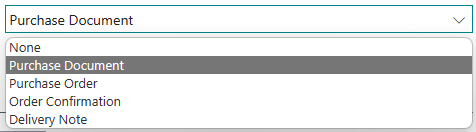
Here you set the Breeze Target Template for this document class. This is the default target template that is used when a Breeze document is created for this document class.
The following are available as standard:
Target Template Setup
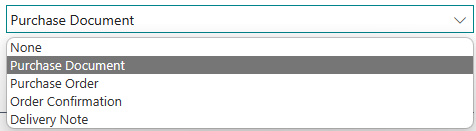
Target templates for the Breeze interface are managed here. These templates are available by default:
General
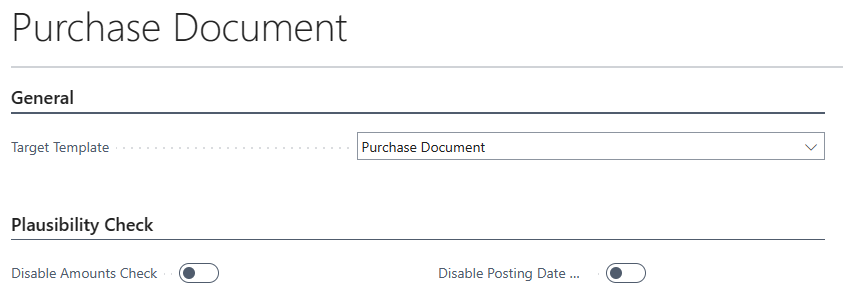
Here you can see which target template is currently being edited.
The Do Not Release toggle (labeled Disable Release on the page) is also located in this group. If enabled, the automatic release of the document created from the Breeze entry is suppressed, so that the document is created but left unreleased for manual processing.
Plausibility Check
Here, certain plausibility checks per target template can be deactivated. This group is only visible when the Target Template is set to a value other than None.
The following toggles are available:
- Ignore Vendor Blocked (Payment) – skips the check of the vendor's payment-blocked status when the block is set to "Payment".
- Disable Amounts Check – deactivates the plausibility check of the document amounts.
- Disable Posting Date Check – deactivates the check of the posting date.
Generic Custom Fields
Customer-specific fields can be added here that extend or deviate from our standard template. This mapping ensures that this additional content is assigned to the right places.

The corresponding BC field is assigned to each technical JSON field name.
On the Breeze side, the fields must be added via the additionalFields.
OAuth 2.0 setup (for SaaS only)
Access to web services in Microsoft Dynamics 365 Business Central (BC) in the SaaS version is only possible via OAuth 2.0. The necessary setup of the app in Azure Active Directory and its link to BC is described below.
For on-premises installations, see Authentication (on-premises).
Azure Portal
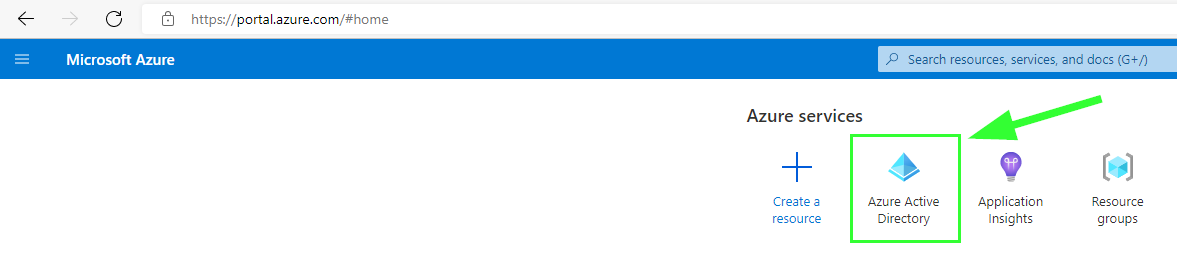
Launch Azure Portal and open Microsoft Entra ID
Create a new app under App registrations
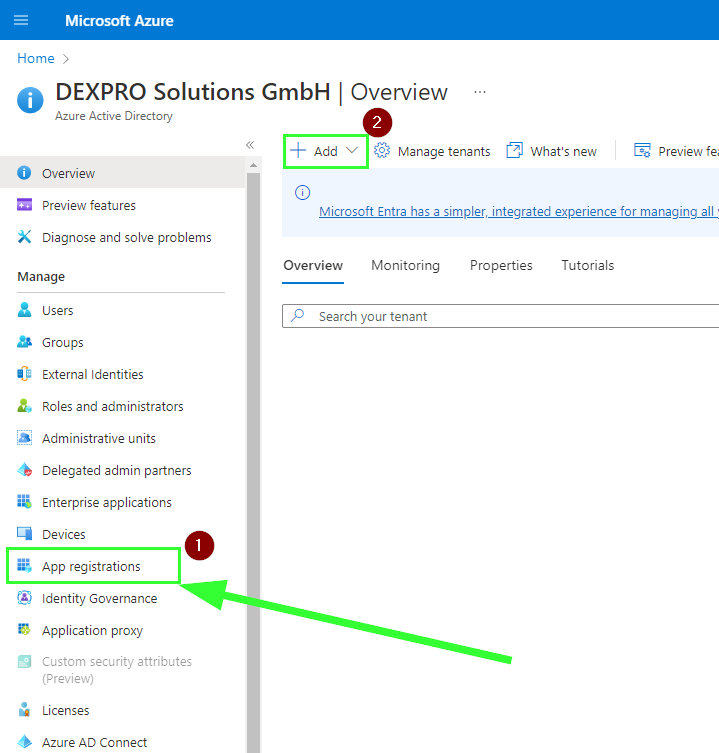
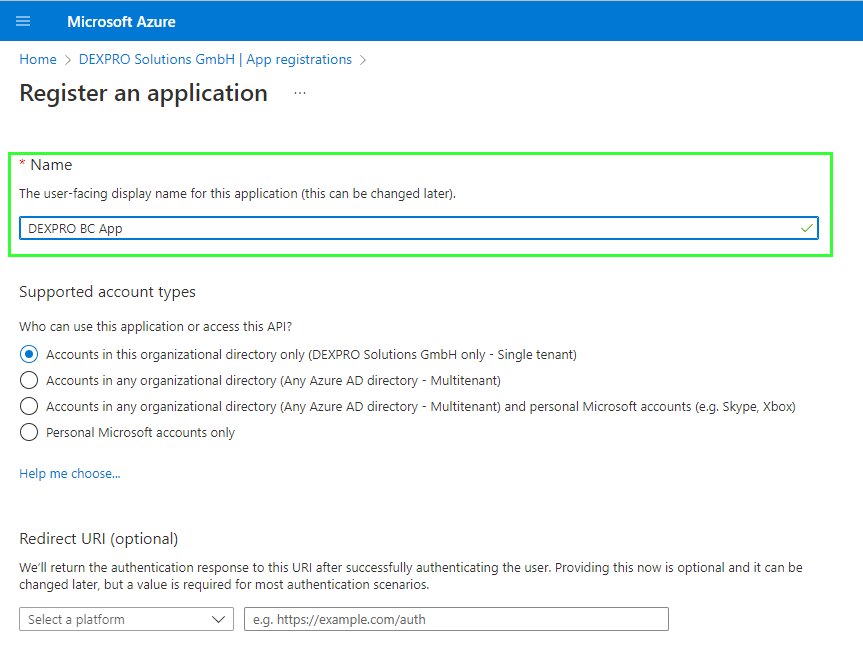
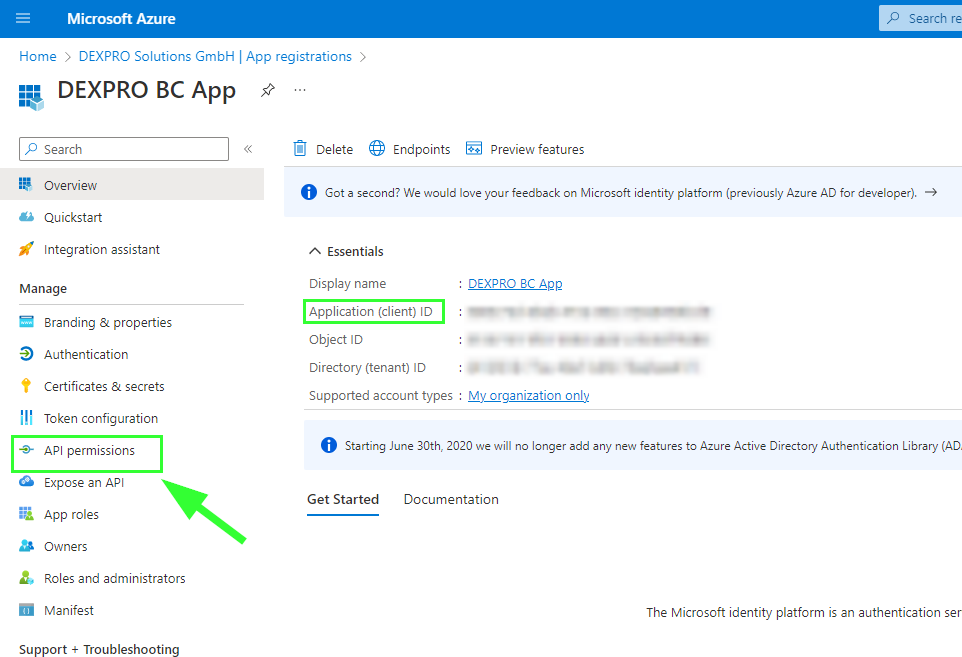
Create API permissions
The Application (client) ID can already be copied and stored at this point (will be needed later)
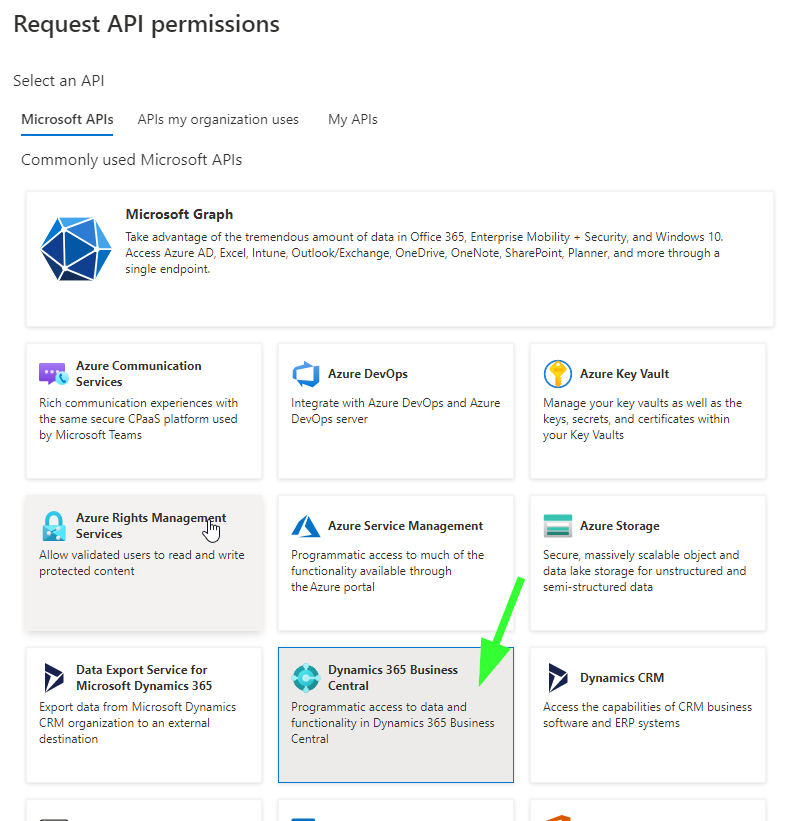
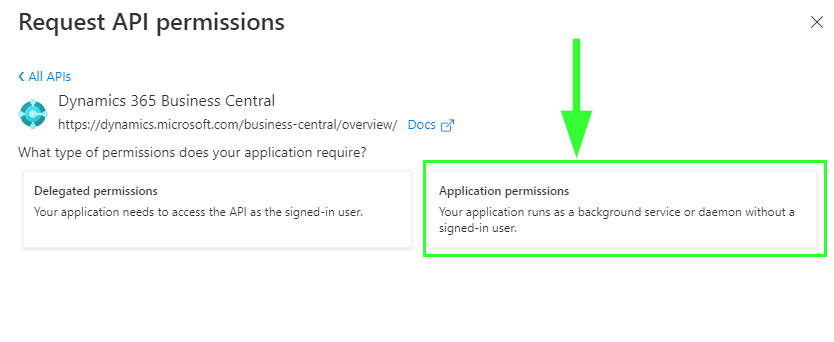
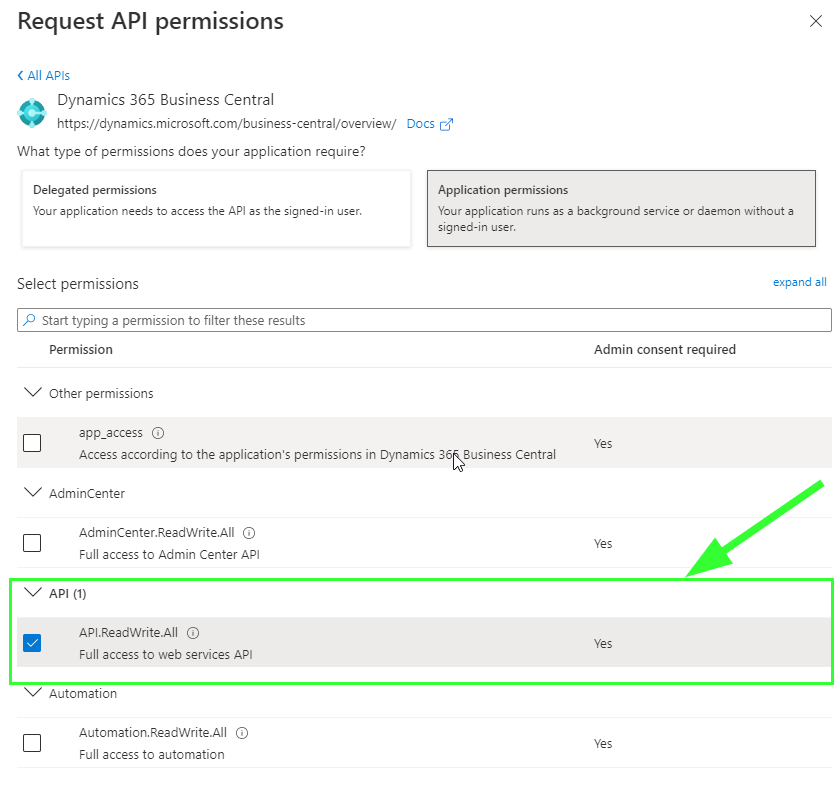
Create Client secret and store it in a secure location
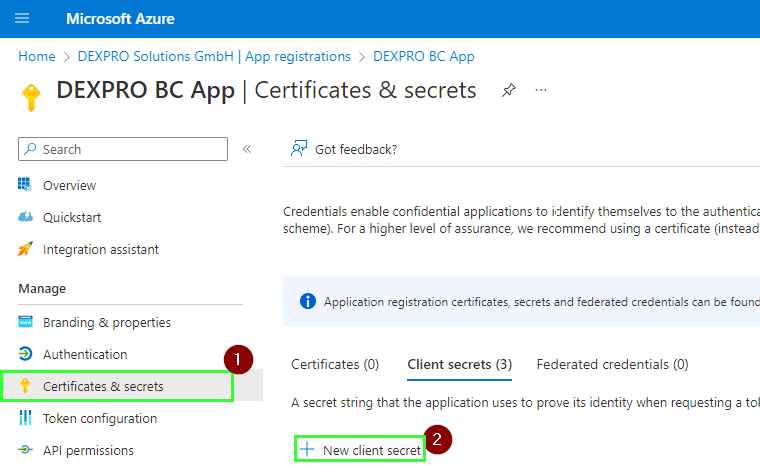
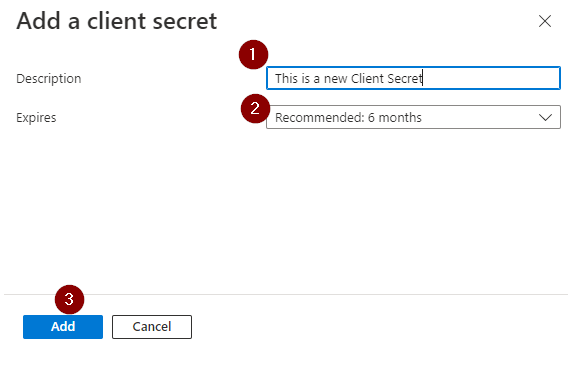
Business Central
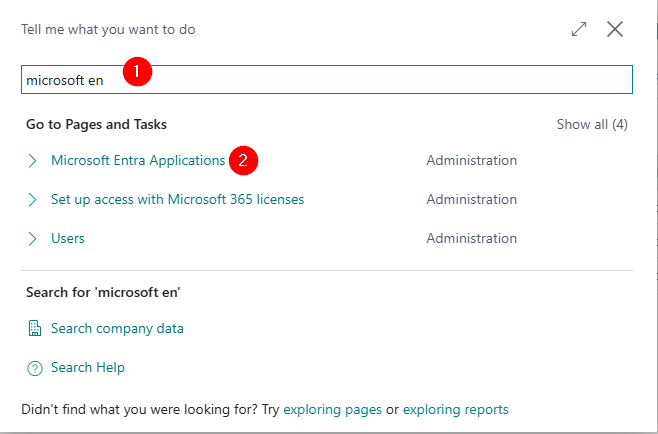
Open Microsoft Entra Applications and create a new entry

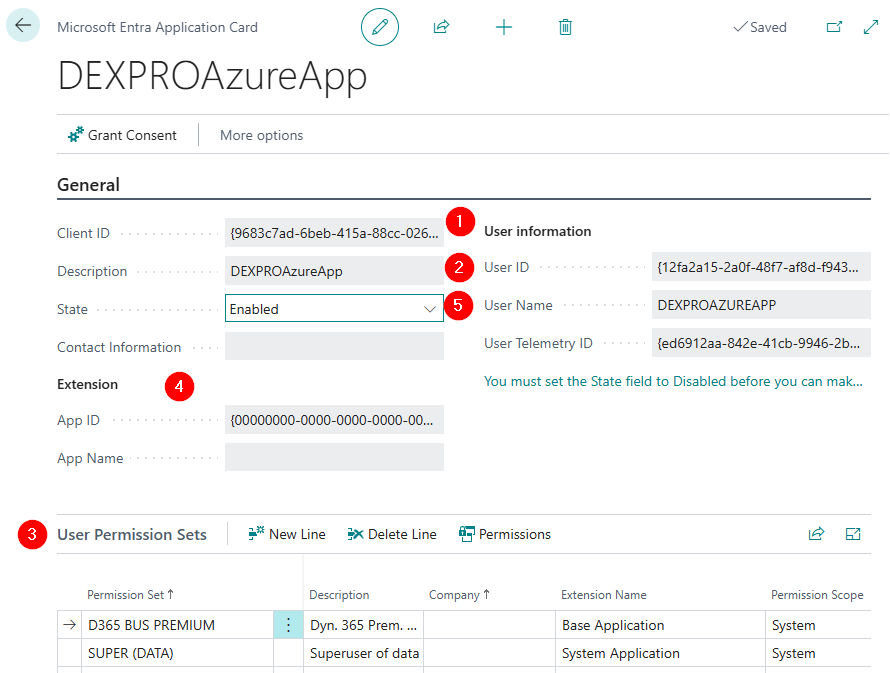
Set up Microsoft Entra Application
- Enter the Client ID
- Enter description (description is a bit misleading. This is rather a user name).
- Assign user permission set(s) individually.
- (Optional)
- Activate application
Breeze Workflow
To connect our Breeze Invoice Workflow to Dynamics 365 BC please read this manual.
Authentication (on-premises)
On an on-premises installation of Business Central, access to the web services is not limited to OAuth 2.0. This page describes how BREEZE and other systems authenticate there. For Business Central online, see OAuth 2.0 setup (for SaaS only).
Difference between SaaS and on-premises
In October 2022, Microsoft switched off authentication with web service access keys (Basic Auth) in Business Central online only. On-premises, Business Central still accepts both methods:
- User name and password: the caller signs in with a BC user and that user's password or web service access key.
- OAuth 2.0: the caller signs in through an app registration in Microsoft Entra ID, as with SaaS.
Connecting BREEZE
BREEZE connects to an on-premises installation through the connection type Dynamics 365 BC (on Prem). This connection type signs in with a user name and password. BREEZE offers OAuth 2.0 only with the connection type Dynamics 365 BC (SaaS). The connection fields are described in the BREEZE documentation under Verbindungen (German).
Prerequisites
- The BC server instance uses the credential type NavUserPassword or AccessControlService. Only these types let the web services accept a user name and password.
- The web services are reachable over HTTPS (SSL). With this method, the credentials travel with every request.
- The OData port of the server instance (often 7048) is reachable from the BREEZE system.
- API services are enabled on the server instance, see Besonderheiten bei BC onPrem (German).
Setup in Business Central
- Create a dedicated user for the interface. The user needs a BC user license.
- Assign the required permission sets to the user, see Permission sets.
- On the user card, in the Web Service Access section, generate a Web Service Access Key. With AccessControlService the key is required. With NavUserPassword the user's password works as well, but the key is still the better choice because it is valid for web services only and can have an expiration date.
- In the BREEZE connection, enter the user name under Benutzer and the web service access key (or the password) under Passwort, then test the connection with Verbindung Prüfen.
Other systems: OAuth 2.0 on-premises
Systems that call the Breeze Interface API directly can also authenticate on-premises with OAuth 2.0 (client credentials flow). This requires the BC server instance to be configured for Microsoft Entra ID with OpenID Connect, and the server parameter ValidAudiences must include https://api.businesscentral.dynamics.com.
The steps in Microsoft Entra ID and in Business Central are then the same as on OAuth 2.0 setup (for SaaS only). Microsoft describes the server-side prerequisites in Microsoft Learn: Using Service-to-Service (S2S) Authentication.
Recommendation
- BREEZE: a dedicated user with a web service access key, using the connection type Dynamics 365 BC (on Prem).
- Other systems: OAuth 2.0 if the server instance already runs with Microsoft Entra ID. No password is tied to the interface, and it is the method Microsoft recommends. Without Microsoft Entra ID, a dedicated user with a web service access key is the simpler option.
Microsoft lists the web service access key as deprecated in its documentation and recommends OAuth 2.0. So far it has been switched off in Business Central online only. When moving to Business Central online, authentication therefore has to change to OAuth 2.0, and in BREEZE to the connection type Dynamics 365 BC (SaaS).