
eInvoice Sender Setup
In the eInvoice Sender setup, both the connection to the DIGIvoice system and the processing within the app are set up.
Menue
Download Configuration
This is used to download the configuration and structure of the e-invoice documents.
Related
Document Queue
You can access the document queue via this menu item.
Process Log
You can access the process log of transactions with Digivoice via this menu item.
Customer Setup
You can access the customer-specific setup via this menu item.
Vendor Setup
You can access the vendor-specific setup via this menu item.
OAuth 2.0 Setup
This menu item takes you to the OAuth 2.0 setup for authentication on the Digivoice system.
Mappings
- Payment Term Keywords
- Unit of Measure Codes
- XR Field Structure
General
In this FastTab, you can activate/deactivate the use of this app and set up the connection to the Digivoice system.

Export Settings
The standards for the export are saved here.

XRechnung 3.0 defaults
The export defaults ship pre-configured for the current XRechnung 3.0 standard. The Business Process Type and Specification Identifier are the two profile fields that identify the e-invoice standard against which each document is generated:
- Business Process Type - default urn:fdc:peppol.eu:2017:poacc:billing:01:1.0.
- Specification Identifier - default urn:cen.eu:en16931:2017#compliant#urn:xeinkauf.de:kosit:xrechnung_3.0 (the XRechnung 3.0 CIUS identifier).
These defaults ensure generated documents declare conformance to XRechnung 3.0. Only change them if you are targeting a different profile and you understand the downstream validation impact.
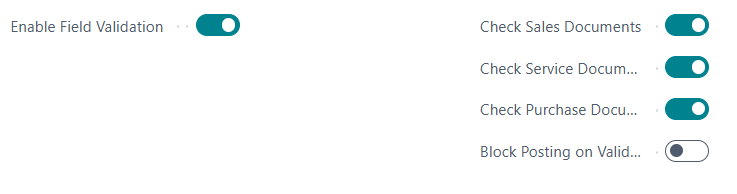
eInvoice Compliance Check
Here you will find the settings for the compliance check.
Document Queue
Here you can specify how long the entries are to be kept.

Expert Settings
The Show Expert Settings toggle hides advanced, low-level configuration by default. It is a UI-only switch (it is not stored in the setup). When you enable it, the following additional groups become visible on the setup page:
- XRechnung - profile identifiers and XRechnung-specific export defaults (see XRechnung 3.0 defaults above).
- XML Validation - settings controlling schema/schematron validation of the generated XML.
- Validation Patterns - the regular-expression patterns used by the compliance rules.
- Object Schemas - the schema definitions describing the document object structure.
Leave Expert Settings switched off during normal operation. These groups define how documents are built and validated - incorrect changes can cause generation or validation to fail.
The behaviour of individual compliance rules (enable/disable, severity override, category and stage) is configured separately - see the Rule Setup page.
No comments to display
No comments to display